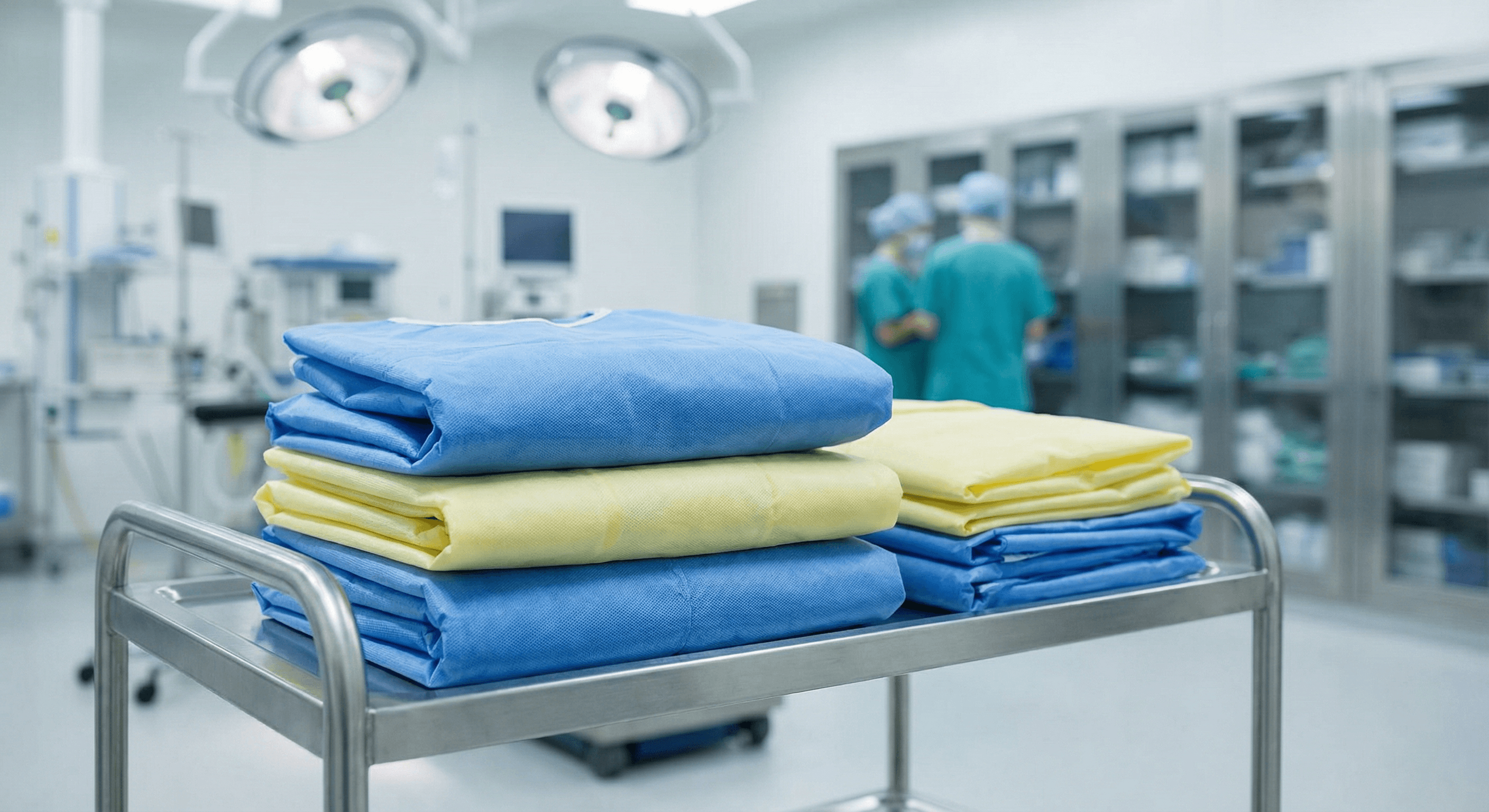
What Are Isolation Gowns?
Isolation gowns are protective garments designed to protect healthcare workers and patients from the transfer of microorganisms and body fluids during medical procedures.
AAMI Classification Levels
The Association for the Advancement of Medical Instrumentation (AAMI) classifies gowns into four levels based on barrier protection:
Level 1 — Minimal Risk
- Basic barrier protection for standard care
- Low fluid contact environments
- Suitable for: basic care, standard medical ward use
Level 2 — Low Risk
- Increased splash protection
- Suitable for: blood draws, suturing, pathology labs
Level 3 — Moderate Risk
- Moderate fluid resistance
- Suitable for: arterial blood draws, emergency care
Level 4 — High Risk
- Maximum fluid and microbial barrier
- Suitable for: surgery, trauma, infectious disease management
Material Options
Non-Woven SMS Fabric
- Spunbond-Meltblown-Spunbond construction
- Good balance of protection and breathability
- Most common for Level 1-2 gowns
Microporous Film Laminate
- Enhanced fluid barrier properties
- Used for Level 3-4 gowns
- Less breathable but higher protection
PE Coated
- Polyethylene coating for fluid repellency
- Economical option for basic protection
- Commonly used in non-critical areas
Key Standards
| Standard | Region | Scope |
| --- | --- | --- |
| AAMI PB70 | USA | Classification and testing |
| EN 13795 | EU | Surgical drapes, gowns, and clean air suits |
| GB 19082 | China | Protective clothing for medical use |
Selection Guide
When choosing isolation gowns, consider:
1. Protection level — match AAMI level to procedure risk
2. Comfort — breathability matters for extended wear
3. Size range — ensure adequate coverage for all staff
4. Closure type — tie-back vs. elastic cuff preferences
5. Sterile vs. non-sterile — based on procedure requirements
Conclusion
Proper gown selection is critical for infection control. SAFEWELL offers isolation gowns across all AAMI levels with full certification and competitive pricing for bulk orders.